
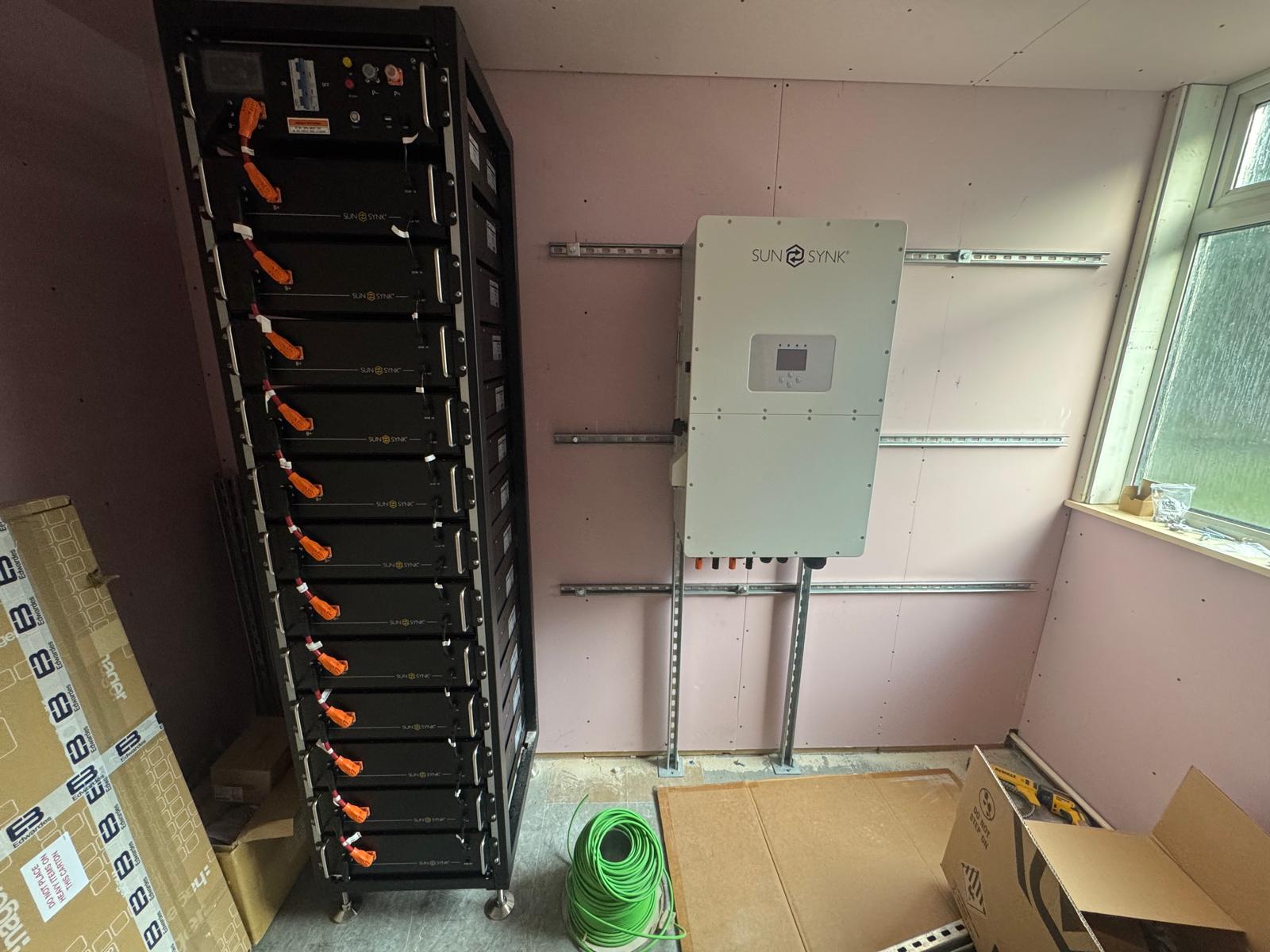
Director’s Insights: Why Commercial Battery Storage Is Becoming More Valuable Than Solar Panels
Battery storage is rapidly becoming the most valuable component of modern commercial solar systems. While photovoltaic panels generate electricity, batteries determine when that energy can be used strategically — improving self-consumption, reducing peak tariffs, and protecting businesses from electricity price volatility.
Over the last 20 years working in the commercial solar industry, I’ve watched several major shifts take place in how energy systems are designed and how businesses think about electricity. One of the biggest changes I’m seeing right now is the growing value of commercial battery storage systems compared with the photovoltaic panels themselves.
That might sound surprising at first. After all, the solar panels are what generate the electricity.
But the truth is that the real power of modern commercial solar installations now lies in how that energy is stored, managed, and deployed.
And that’s where commercial battery energy storage systems (BESS) are rapidly becoming one of the most valuable assets in the entire renewable energy ecosystem.
The Evolution of Commercial Solar Systems
When I first started working in solar, most installations were relatively simple. We installed photovoltaic panels, connected them to string inverters, and exported electricity directly back to the grid.
In many cases, the energy never even stopped at the building it was installed on.
That model worked at the time, particularly when the Feed-in Tariff created strong incentives for exporting electricity. But it also created a frustrating reality for many customers: even though they had solar panels on the roof, they still ended up paying electricity bills because they were exporting power during the day and buying it back at night.
For businesses and homeowners in remote areas or rural locations, this was even more limiting. The grid dictated how much solar could be installed, and excess generation simply had nowhere to go.
Today, battery storage has completely changed that equation.
Solar Panels vs Battery Storage – Understanding the Value
Solar panels remain one of the most reliable pieces of energy infrastructure ever produced.
Most commercial solar panels come with:
A 25-year linear power warranty
A 20–25 year performance guarantee
Expected operating lifetimes that often exceed 30 years
Panel performance has also improved steadily over time, with efficiency levels increasing while manufacturing costs have dropped dramatically.
But what makes solar far more powerful today is how it works alongside battery storage technology.
A commercial solar battery system allows businesses to:
Store excess solar energy during the day
Use that electricity during evening peak pricing periods
Reduce demand charges
Increase self-consumption of solar generation
Provide backup power and energy resilience
Instead of exporting energy at low value, businesses can now store and deploy electricity strategically.
In other words, solar produces the energy — but battery storage decides when that energy becomes valuable.
The Explosive Growth of Battery Storage
The rise of commercial battery storage systems is not just anecdotal — the data behind the industry is extraordinary.
Over the past five years alone, battery storage has seen some of the fastest growth in the entire energy sector.
Some key figures illustrate the scale of the shift:
Lithium-ion battery prices have fallen over 90% since 2010, dropping from around $1,400 per kWh to under $140 per kWh.
Over the longer term, battery prices have fallen 97% since 1991, one of the steepest cost declines of any modern technology.
The global lithium-ion battery market exceeded $150 billion in 2025, growing more than 20% year-on-year.
The UK battery storage market is projected to grow from roughly $227 million in 2024 to nearly $7 billion by 2035, demonstrating extraordinary market expansion.
Battery energy storage systems globally are expected to grow from roughly $11.5 billion in 2025 to $96 billion by 2035, representing annual growth rates above 26%.
At the same time, the European market for battery energy storage connected to solar systems is expected to grow roughly six-fold by 2029, reaching almost 120 GWh of installed capacity.
When you combine those figures with rising electricity prices, the economic case for solar plus battery storage systems becomes extremely compelling.
Why Batteries Are Becoming the Most Valuable Part of the System
From a technical perspective, photovoltaic panels will always be essential — they are the generation technology.
But from a commercial energy strategy perspective, the value is increasingly shifting toward the energy storage layer.
Why?
Because batteries allow businesses to:
Arbitrage electricity prices
Avoid peak tariff periods
Improve energy independence
Participate in grid services and demand response markets
Protect against electricity price volatility
A well-designed commercial solar and battery storage system can effectively turn a building into a mini power station with controllable energy output.
That level of control simply didn’t exist in the early years of solar deployment.
Monitoring, Smart Systems and the Rise of Energy Intelligence
Another development I’ve found incredibly exciting is the evolution of monitoring, metering, and smart energy management systems.
Modern commercial solar and battery installations now include:
Real-time energy monitoring platforms
Smart metering and consumption analytics
AI-driven energy optimisation
Automated load management systems
Businesses can now see exactly when electricity is generated, stored, exported, or consumed.
That level of transparency has completely transformed how organisations think about energy infrastructure and energy investment.
Instead of energy simply being a utility bill, it becomes a data-driven operational asset.
A Personal Perspective
Personally, I’ve been incredibly excited about the role of commercial battery storage for years.
Working on commercial and domestic battery projects has opened up entirely new possibilities within the solar industry.
We now have the ability to design systems that genuinely reduce reliance on the grid, allow larger solar arrays to be installed in constrained areas, and give businesses far greater control over their electricity usage.
What used to be a one-directional energy system — panels producing electricity that immediately went back to the grid — has now become a flexible, intelligent, and controllable energy ecosystem.
Solar generation was the first revolution.
But the battery revolution is what unlocks its full potential.
And in my view, as the commercial solar and battery storage industry continues to mature, energy storage will increasingly become the most valuable component in modern renewable energy systems.
Book a Business Load Profile Assessment
We analyse your half-hourly electricity consumption to identify:
Peak shaving potential
Load shifting opportunities
Demand charge exposure
Battery sizing strategy
Financial modelling scenarios
This allows you to understand whether commercial battery storage solutions would materially improve your cost structure before any investment decisions are made.
If you're exploring solar or battery storage, the first step is understanding how your building actually uses electricity.
👉 Book a Business Load Profile Assessment
👉 Speak with a solar consultant
Data and market statistics referenced in this article are drawn from publicly available reports from global energy research organisations.
References
- BloombergNEF – Lithium-ion battery pack prices have fallen dramatically over the past decade, declining more than 90% since 2010 as manufacturing scale and technology improvements have accelerated.
https://about.bnef.com/blog/lithium-ion-battery-pack-prices-hit-record-low/
- International Energy Agency (IEA) – Global energy storage deployment continues to accelerate as renewable generation expands and electricity systems become more flexible.
https://www.iea.org/reports/energy-storage
- National Grid ESO – Battery storage is expected to play a critical role in balancing electricity supply and demand within the UK energy system as renewable generation increases.
https://www.nationalgrideso.com
- Aurora Energy Research – The UK battery storage market is projected to grow rapidly as grid flexibility becomes increasingly valuable in modern energy systems.
- European Association for Storage of Energy (EASE) – Energy storage technologies are expanding rapidly across Europe as governments transition toward low-carbon electricity systems.
- International Renewable Energy Agency (IRENA) – Renewable power generation and energy storage technologies are increasingly being deployed together to improve energy system flexibility and reliability.
Found this helpful?
Share this post with others who might benefit.
Related Articles
Why Businesses Need Independent Solar Consultants Before Signing Solar Contracts
The latest coverage around UK grid upgrades and rising energy costs should make businesses pause before signing solar, battery storage, or wider energy infrastructure contracts. Independent Solar Consultants is an independent commercial and technical solar consultancy led by Justin Dring, built to help businesses sense-check design, cost, grid risk, and long-term performance before they commit capital.
Solar Is No Longer a Sustainability Project. It Is a Commercial Performance Strategy.
The Sustainable Views article, “The next sustainability mandate is commercial performance,” makes a point every serious business should pay attention to: sustainability is no longe...
Commercial Energy Price Cap: Why Businesses Still Need Stronger Protection
Ofgem’s latest guidance on the **commercial energy price cap** makes one thing very clear: businesses, charities and many other organisations are not protected in the same way as domestic energy customers. Independent So...